


Team Development
Constant change, hybrid structures and new requirements are challenging teams today.
In my work, I also observe that there is often a lack of clarity, trust and a common direction. Goals are unclear, roles and responsibilities are not coordinated, and tensions weigh on the atmosphere.
This not only weakens cooperation and costs energy, but also affects the future viability of your company.
Whether at the start, during periods of change or when cooperation is not running smoothly, targeted team development creates clarity, strengthens cooperation and enables teams to take action.
What next step would be good for your team?
What often makes teamwork difficult today

Unclear roles, unclear responsibilities
Who is responsible for what? This is constantly discussed without result. Tasks are left undone or duplicated. Responsibility is shifted. This creates friction and frustration.
No common goal
The team works alongside each other instead of with each other. There is a lack of common direction and a clear understanding of what they are working towards together.
Silo thinking instead of cooperation
The team thinks in terms of boundaries rather than solutions. Communication stalls, tensions arise and mutual expectations are unclear. All of this blocks cooperation and ultimately harms your customers.
Difficult topics are avoided
A lack of openness and dialogue means that conflicts are not addressed. Emotions build up, trust suffers and the actual work loses focus.
Hybrid Distance
Distributed locations, home offices, changing attendance: the connection within the team is lost. Communication is laborious and coordination costs time and energy.
Firefighting instead of further development
The team is under constant stress. ‘Putting out fires’ is a common description of everyday life. Everything is urgent, but nothing really has direction. Reflection and development are neglected. As a result, potential remains untapped.
What Good Work means to me.
Strengthening teamwork
Good work means empowering teams to organise themselves, develop further and overcome challenges on their own initiative. In complex environments, the best solutions do not come from individuals, but from working together. Openness, trust and shared responsibility are not soft skills, but central prerequisites for performance, innovation and sustainability.
How your team can benefit from team development
Greater clarity within the team
Roles, tasks and expectations are clarified. The team takes on more responsibility and organises itself in a solution-oriented manner in everyday life.
Genuine connection
Open communication improves cooperation, even across different locations. Tensions are resolved directly. The team grows closer together and gains new confidence.
Better collaboration in everyday work
There are concrete agreements for everyday collaboration. Meetings become more productive and coordination easier. The team is once again pulling in the same direction.
More innovative energy
When people feel effective and competent, inspiration and motivation arise. The team thus becomes the driving force behind your company’s value creation and future viability.
None of us is as smart as all of us.
Ken Blanchard

When team development makes sense
New team or reorganisation: When new teams need to grow together or existing teams need to reorganise.
When cooperation is disrupted: For example, when goals are unclear, roles are undefined, communication is stalled or cooperation at interfaces is difficult.
Tensions and conflicts: When conflicts block progress or remain unspoken and put strain on the team.
Changes in the company: When there is new leadership, a change in strategy or reorganisation.
Reflection: When the team wants to consciously review and strengthen its cooperation.
Process support: When working methods or processes in the team change and need to be designed jointly.
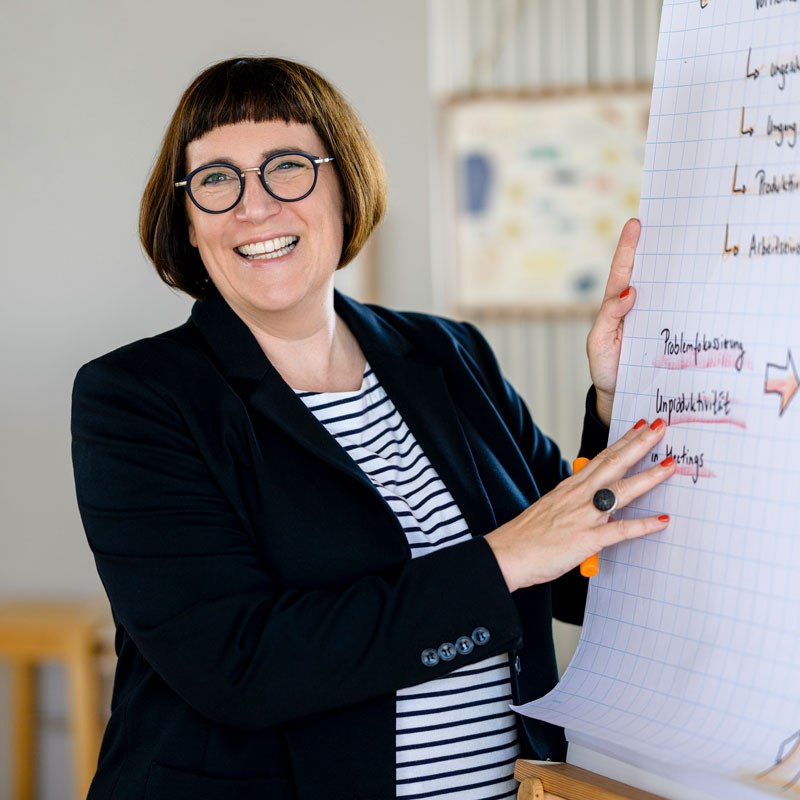
Work with me if you…
are not looking for team events with a short half-life, but rather genuine development that noticeably improves everyday working life.
want to strengthen teamwork: with clarity, structure and an open mind for what is left unsaid.
believe that strong teams are not created through pressure, but through trust, personal responsibility and joint development.
want to create a safe space where even difficult topics can be addressed and dealt with constructively.
want someone at your side who accompanies team processes with experience, empathy and a systemic view.